


A senior leader at one of the country’s most admired companies recently described her employer’s AI rollout in two words:
“Hunger Games.”
Some employees got the tools. Others didn’t. Nobody got trained. Then the company began evaluating people based on how many hours they logged using AI.
She wasn’t afraid of the technology. She was angry.
Her anger points to a mistake many organizations are making. They are treating AI adoption as a technology problem when it is really a trust problem. Employees need to believe that the institution handing them these tools understands their interests, will share the benefits fairly, and is telling the truth about what comes next.
The same dynamic is playing out across the country. The institutions building and deploying AI are asking people to accept enormous change before they have earned the trust to lead it.
The fight over data centers offers the clearest evidence. According to Data Center Watch, at least 75 projects worth approximately $130 billion were blocked or delayed during the first quarter of 2026. The immediate disputes involve electricity rates, water use, noise, and pressure on local infrastructure.
But the fight is bigger than the buildings.
Data centers have become symbols of a broader fear: AI’s benefits will land on corporate balance sheets while the costs—higher power bills, lost jobs, a strained grid, disrupted communities—land on everyone else.
That fear did not come from nowhere. The public remembers Silicon Valley’s last big promise. Social media was supposed to bring us together. Instead, its platforms exploited our data, deepened division, and weakened the institutions holding the country together.
Now the industry is making another sweeping promise: AI will change everything, and the public should trust its leaders to manage the transition.
According to Anthropic’s own survey, just 15% of Americans do.
The industry’s reflex is to treat that resistance as a communications problem. In April, the Wall Street Journal described an industry-wide “charm offensive” designed to head off backlash. Warnings about mass job loss were giving way to talk of four-day workweeks and AI-funded wealth funds.
Some of those ideas have merit. But the industry is still betting that resistance can be overcome with a better explanation and a friendlier narrative.
People aren’t confused about what the industry is promising. They don’t trust the people making the promise.
Public Health Already Ran This Experiment
I’ve seen where this leads.
During the pandemic, I helped build the Health Action Alliance, which worked with employers to deliver credible health information to millions of workers. Companies stepped into a vacuum because many employees trusted their employer more than the public institutions charged with protecting their health.
For decades, public health relied on scientific authority to carry its recommendations. During the pandemic, that authority often hardened into a model of compliance: the science was settled, protective measures were necessary, and the public was expected to fall in line.
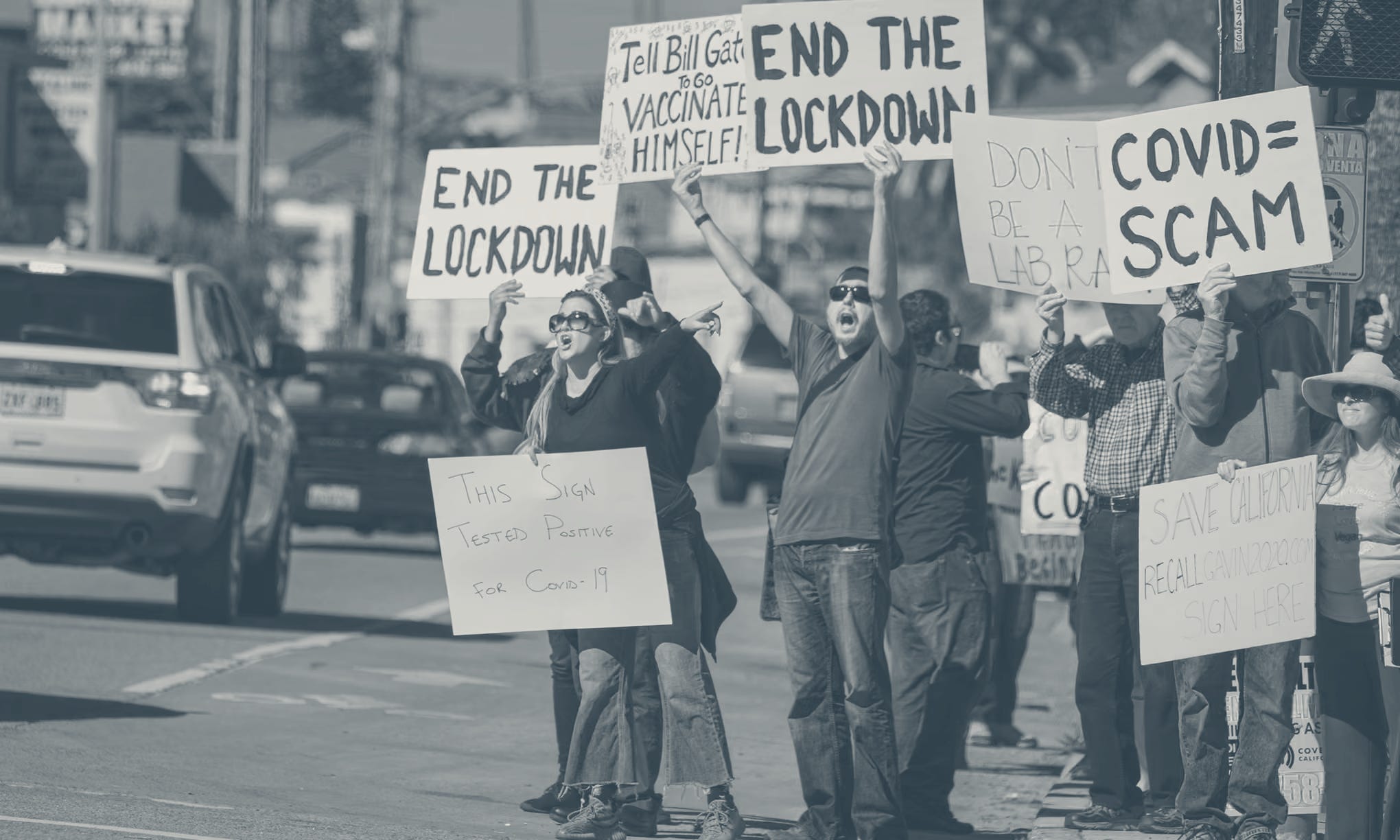
Millions of Americans rejected that model. The battles over masking and vaccine mandates morphed into battles over individual liberty, institutional authority, and who had the right to make consequential decisions for whom. Too many public health leaders confused the strength of the scientific case with the legitimacy of every policy built upon it.
The backlash did not remain diffuse. It quickly found a story, a community, and a political machine capable of channeling it. The Make America Healthy Again movement is one expression of what happens when real grievances about health, power, and institutional accountability are gathered into a larger populist narrative. The grievances were real, even when some of the claims built around them were not.
MAHA’s organizers understood something traditional institutions were slow to recognize: trust increasingly moves sideways in our society, through relationships, identity, and belonging. Institutions keep expecting it to flow downward from credentials.
Public health is still paying for that failure. AI leaders are now risking the same mistake on a much faster timeline.
Jobs will change. Work will be redesigned. Data centers will be built. The only question, we are told, is how quickly everyone accepts this and adjusts.
But inevitability does not create legitimacy.
People do not accept change simply because a powerful institution declares it unavoidable—especially when they had no role in the decision and little reason to believe they will share in the benefits. If AI leaders keep demanding compliance instead of earning trust, the backlash will not remain scattered. It will find its own story and political home.
In fact, that is already happening.
On July 14, New York Governor Kathy Hochul, a Democrat, signed the nation’s first statewide moratorium on new hyperscale data centers, pausing construction while the state develops standards for energy use, utility costs, and environmental impact. Polling showed broad, bipartisan support for the pause. Skepticism of the AI buildout, in other words, has become good politics.
Four days later, HumansFirst—a conservative movement chaired by former Tea Party organizer Amy Kremer—coordinated 142 protests against AI data centers across 42 states. Kremer compared the moment to the conditions that produced the Tea Party: a base convinced that the people in charge have stopped listening.
A Democratic governor and a Tea Party veteran, arriving at the same target from opposite directions. That is what a political machine looks like as it begins to take shape.
A backlash with broad bipartisan appeal will be much harder to answer than a bad headline.
Transformation Happens One Person at a Time
Every business transformation is ultimately a collection of personal transformations. A company does not adopt AI. Its people do.
One employee learns a new tool. Another wonders whether it will eliminate her job. A manager has to redesign the work of an entire team.
The quality of an organization’s AI transformation will depend on how well it supports people through those transitions. Scoring employees on tokens or hours logged tells a company almost nothing about whether AI is improving the work.
Through the Health Action Alliance, we saw that the most credible employer policies were shaped with the people expected to live under them. Leaders acknowledged workers’ concerns, spoke honestly about what remained unknown, and gave employees a voice in how policies would work.
AI transformation requires the same discipline.
Train people before evaluating them. Tell the truth about which jobs will change. Give workers a meaningful role in redesigning their own work. And when the technology creates gains, let workers experience some of the benefit rather than encounter AI only as the pretext for another round of layoffs.
The same principle applies outside the workplace. Whether the change is a new tool on an employee’s desktop or a data center on the edge of town, people are more likely to accept it when they have some hand in shaping it, understand the costs, and can see where the gains will go.
Better messaging cannot create trust. Trust has to be earned through how an institution operates.
The Tougher Question
Silicon Valley could build the most consequential technology of a generation, win the capability race, and still lose the country.
Trust, unlike compute, cannot be purchased. It is granted to institutions that demonstrate through their actions that they understand people’s interests and intend to protect them. It is withdrawn when people conclude that decisions are being made somewhere else, by people who will never live with the consequences.
Right now, trust is being withdrawn.
The way forward is to involve people before decisions are final, tell the truth about the tradeoffs, share the gains, and accept accountability for the harms. No charm offensive gets there.
Every executive deploying AI is asking the same question: How do we get our people to use it?
There is a tougher question underneath it: What would we have to do to deserve their trust?
Public health has already shown what happens when institutions skip that question. AI leaders and employers are now deciding whether to repeat the mistake.

Stephen Massey is Co-CEO of Meteorite, where he helps companies and organizations work together to solve problems too big to solve alone. He is the founder of the Health Action Alliance and a co-architect of the Civic Alliance.
This post is part of his Structurally Sound series, which brings structural thinking to the big problems leaders are wrestling with, in business and in life. The views expressed are his own and don’t necessarily represent Meteorite, its clients, partners, or initiatives.
Stephen, thank you for this. There are structural trust questions here at several levels and to me the most unsettling is the fact that AI companies seem to have zero desire to earn trust from, or even treat with dignity and respect, other humans. I'll leave that aside for now and turn to your question of how employers earn enough trust that their employees are open to exploring AI as a useful tool (rather than a threat). I appreciated the example in your last post about Ezra Klein's team tapping bots to help them get more curious and dig deeper for richer stories. My assumption is that because he has earned the trust of his team, together they found ways to use AI with the goal of increasing satisfaction and purpose in the work — not to "manufacture time," work more, get rid of research staff, produce more podcasts faster, etc. Alongside trust comes social connection, as vital in the workplace as in our communities. Social media isolated us; AI can isolate us further (see all the glowing articles about how "AI can help solopreneurs make millions without a single employee!"). When humans trust each other, are trusted by their leaders, and work in a place that creates and incentivizes social connection and wellbeing as part of the bottom line, AI can take its rightful place, as a tool to serve the team.